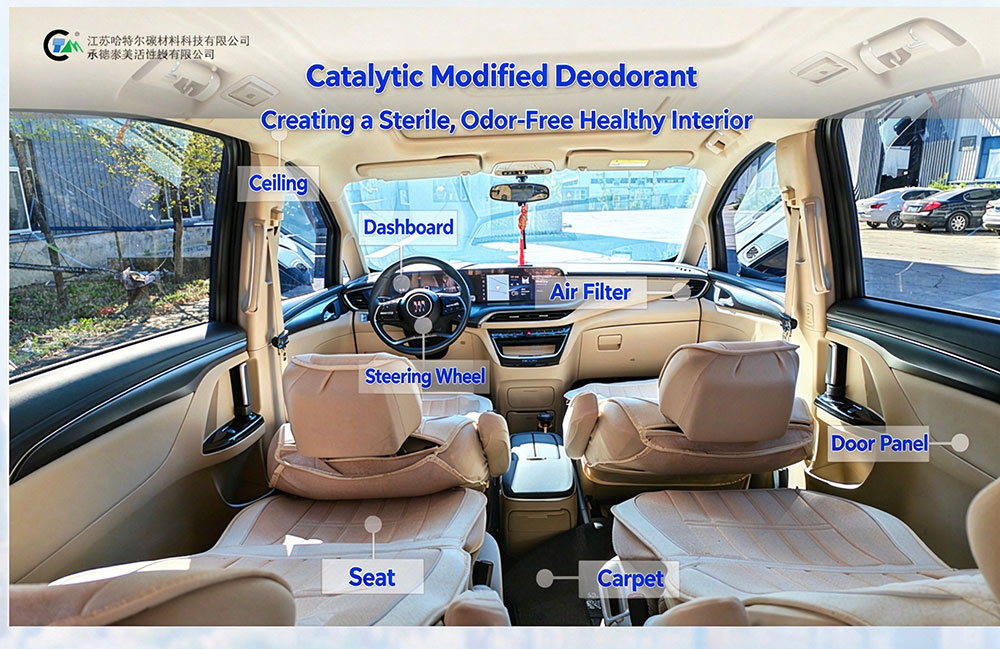
Activated carbon designed for TVOC removal in vehicles serves as a catalyst support medium, primarily utilized for automotive interior applications.
This deodorizing agent is produced by combining porous carbon with catalytic modification technology. Porous carbon—derived from carbonaceous materials through carbonization and activation—features an extensive pore structure and a vast specific surface area, making it highly effective as an adsorbent, a catalyst, or a catalyst support.
The TM-G106 catalytically modified deodorizing agent is capable of adsorbing and degrading TVOCs. Its performance is influenced by its intrinsic properties—such as pore structure, specific surface area, and surface functional groups—as well as environmental factors, including pressure, temperature, airflow velocity, contact duration, gas-phase concentration, and molecular size.
Generally, higher pressure, lower temperature, slower airflow, longer contact time, and larger molecular size (or higher concentration of the adsorbate) contribute to superior adsorption and degradation performance.
Through surface catalytic modification, the functional groups of the porous carbon can be adjusted to specifically target and degrade TVOCs and ozone; this modification technology is a critical factor in determining the overall treatment efficiency.
Product Name
| Deodorant Catalytic Modification
| Specification
| 50-120
|
Product Model
| TM-G106
| quantity
| 20 tons
|
Inspection items
| Standard requirements
| Inspection items
| Standard requirements
|
Specific surface area (BET m2/g)
| >1300
| Ash content (%)
| <6
|
Moisture (%)
| <10
| Packing density (g/ml)
| 0.40-0.50
|
Metal oxide content (%)
| >2.5
| Benzene adsorption value (%)
| >60
|
granularity(%)
| 50-120 mesh
| >50 points (50 points above)
| ≤0.5
|
| >60 stitches (60 stitches above) | ≤15 |
| 60-100 | ≥80 |
| <100 points (100 points below) | <5 |
Notes:
① The technical indicators in the table can be adjusted according to user needs.
② Testing methods: Particle size, benzene adsorption value, moisture, ash content, and packing density are tested according to GB/T 12496-2015 "Test Methods for Wood-based Activated Carbon". Specific surface area is tested according to GB/T 12496.4-1999 Micromeritics ASAP 2460 "Test Methods for Wood-based Activated Carbon". The detection of metal oxides is according to US EPA 3052:1996 & US EPA 6010D:2018.
③ Packaging: 20kg/drum, inner plastic outer PE drum, wooden pallet packaging.
④ Most tests are based on powder-200 mesh. The company's core technical indicators in the above parameters table are not included due to confidentiality. |


 Chinese

 National Service Hotline:




